
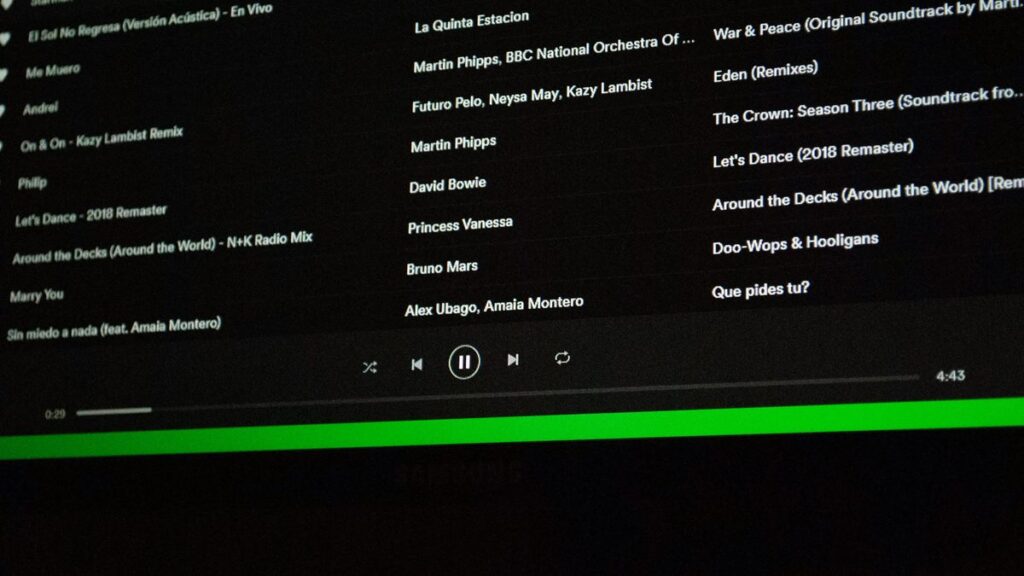
An album used to be a physical object with a middle. You put on side one, you got up, you turned it over, and the act of turning it over was part of the structure. Artists wrote for that break. They put a closer at the end of side one that earned the pause, and an opener on side two that justified you coming back. The compact disc removed the flip but kept the shape, because everyone had grown up with it and because a record still arrived as a sealed thing with a running order somebody had argued about.
Streaming did not abolish the album. It abolished the assumption that anyone would hear it in order.
The front-loading problem
The most visible consequence is that records got front-loaded. When the listener’s attention is the scarce resource and the skip button is always within reach, the opening minutes carry a weight they never used to. The old idea of an album that unfolds — two atmospheric tracks establishing a mood before anything happens — becomes a structural risk rather than a bold choice.
You can hear the adaptation. Intros shortened. Choruses arrive earlier. The slow-burn opener that was a mark of confidence in the vinyl era has largely migrated to track three or four, where it functions as a change of pace for listeners who have already committed, rather than as a test of patience for listeners who have not.
None of this is inherently worse. Getting to the point quickly is a discipline, and plenty of great records have always done it. What is lost is a particular kind of ambition: the record that asks you to trust it for six minutes before it shows its hand. Those still get made, but they are now a deliberate stance rather than a default.
Interludes, skits and the death of the palate cleanser
The interlude has had a strange time of it. In the album era, a short instrumental passage or a spoken fragment served as connective tissue. It reset the ear between two heavy tracks. It made a forty-five minute listen feel like a journey rather than a queue.
On a platform where each track is a discrete unit that either gets played or does not, an interlude is a peculiar object. It gets skipped by listeners who are treating the record as a playlist. It gets kept by listeners who are treating it as a record. Artists have responded in two opposite directions. Some have removed them entirely, producing albums of nothing but complete songs, which can feel relentless. Others have folded the interlude into the song it precedes, so the atmospheric minute is the first minute of the next track rather than a track of its own — the sequencing survives, disguised as an intro.
That second solution is the more interesting one, because it shows artists deliberately working around the format rather than surrendering to it.
The playlist as a rival editor
The deeper change is that a curated playlist is a competing act of sequencing, made by someone who did not write the songs. When a track is placed between two other artists’ work, everything about it changes: its key relationship to what came before, its tempo relative to its neighbours, whether its quiet opening reads as tension or as a mistake.
Some artists have learned to write tracks that survive that treatment — songs robust enough to work cold, out of context, with no preparation. Others have doubled down on context, making records whose individual tracks are noticeably diminished when extracted. Both are legitimate. But an artist now has to decide which they are making, and that decision did not exist in the same form thirty years ago.
Length, and the strange return of the long record
One of the more counterintuitive developments is that albums did not universally get shorter. Some got dramatically longer, because a long tracklist is a wider net. If listening is measured per track and every track is a separate opportunity to be heard, there is a structural incentive to include more of them.
The result is a split. On one side, tight records that treat brevity as a virtue and end before they outstay their welcome. On the other, sprawling releases that function less like an album and more like a catalogue: here is everything, take what you want. The sprawling ones are frequently criticised for lacking editing, and often that criticism is fair. But it is worth noticing that they are not failed albums. They are a different object that happens to be delivered through the album’s packaging.
What sequencing still does
For all this, sequencing has not become pointless, and the artists who take it seriously are still producing something the shuffle cannot replicate.
- Key and tempo relationships. Two songs in adjacent keys, played back to back, produce a lift that neither produces alone. A sudden drop in tempo after three fast tracks feels like an event. These effects are only available in a fixed order.
- Recurring material. A melodic phrase introduced quietly in track two and stated in full in track ten is a reward for listening straight through, and it is invisible to anyone who did not.
- The closer. A final track that resolves something is one of the oldest pleasures in recorded music, and it is entirely dependent on you having heard the eleven tracks before it.
These are not nostalgic pleasures. They are structural ones, and they explain why records that appear designed for sequential listening still find dedicated audiences, and why the vinyl revival is not simply a preference for warm-sounding formats. Buying a record and putting it on is a commitment device. It makes the skip button inconvenient, and inconvenience turns out to be a feature.
Listen to it in order once
The practical suggestion, and it is a small one, is to give any album you care about a single uninterrupted pass in the order the artist chose, before you extract the three songs you like into a playlist. Not out of purism. Out of curiosity about what the sequencing was doing.
Quite often the answer is nothing much, because the running order was assembled without much thought and the record is simply a collection of songs. That is fine and worth knowing. But often enough there is a structure there — a build, a pivot, a track that only makes sense because of the one before it — and once you have heard it, the playlist version sounds like a summary of a book rather than the book.