
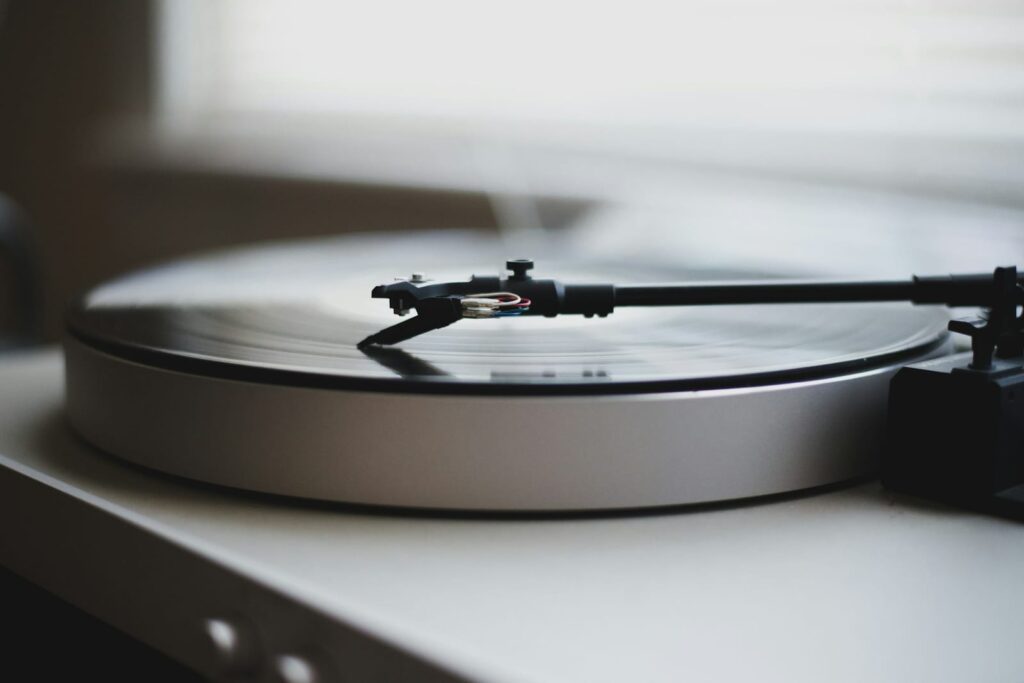
Vinyl never really went away, but over the last decade it has become one of the most popular ways to own music again. Record stores are busy, new albums come out on vinyl as a matter of course, and in 2020 the RIAA reported that record revenues in the United States had passed CD revenues for the first time since the 1980s. If you want in, the first big decision is the turntable, and it is also where most beginners either overspend or buy something that quietly damages their records.
Here is how to choose a budget turntable that sounds good, treats your records well and leaves room to upgrade later.
Avoid the cheapest suitcase players
The all in one suitcase record players sold in gift shops look charming and cost very little. The problem is what is inside. Many use basic cartridges and tonearms that press down on the record harder than they should, which can wear the grooves faster, and their tiny built in speakers do not do vinyl justice. If you plan to build a collection, spend a little more on a proper entry level turntable. It will sound better, and it will be kinder to records you may want to keep for decades.
The parts that matter
A turntable is a simple machine, and a few parts decide most of how it sounds.
- Platter and motor. The platter spins the record. It needs to turn at a steady speed, because any wobble is audible as a warble in the music.
- Tonearm. The arm that carries the cartridge across the record. A good one is rigid and lets you set the tracking force, meaning how hard the stylus presses into the groove.
- Cartridge and stylus. The cartridge converts the tiny movements of the stylus, the needle, into an electrical signal. It has a bigger effect on sound than almost anything else, and on many turntables it can be upgraded later.
Belt drive or direct drive?
Most budget turntables use one of two designs.
- Belt drive models place the motor off to one side and turn the platter with a rubber belt. The belt helps isolate the platter from motor vibration, which is why many hi fi turntables use it. Belts stretch over time and need replacing every few years, which is cheap and easy.
- Direct drive models put the motor right under the platter. They get up to speed quickly and hold it well, which is why DJs use them. Good direct drive decks are excellent for home listening too.
At the budget end, either can sound great. The quality of the overall design matters more than the drive type.
Automatic or manual?
An automatic turntable lowers the arm onto the record at the press of a button and lifts it at the end. That is convenient and protects your records from clumsy hands, which makes it a good choice for beginners or for households with children. A manual turntable asks you to lift and lower the arm yourself, usually with a cueing lever that does it gently. Manual designs have fewer moving parts and often put more of their budget into the arm and platter.
Do you need a phono preamp?
This is the part that confuses most beginners. The signal from a turntable cartridge is very weak and needs special amplification and equalization before it can go into ordinary speakers or an amplifier’s regular inputs. That job is done by a phono preamp, also called a phono stage.
You have three options:
- A turntable with a built in preamp. Many budget models include one, often with a switch so you can bypass it later. This is the simplest route.
- An amplifier or powered speakers with a phono input. Look for an input marked “phono.” If you have one, you can use a turntable without a built in preamp.
- A separate phono preamp. A small box that sits between the turntable and your system. It is also a common upgrade path.
Check this before you buy, because a turntable plugged into the wrong input will sound very quiet and thin.
Speeds
Full size albums play at 33 1/3 revolutions per minute, a format Columbia Records introduced in 1948. Seven inch singles usually play at 45 rpm, the format RCA Victor launched in 1949. Almost every turntable handles both. Some switch speeds with a button; others ask you to move the belt to a different part of the motor pulley by hand. Old 78 rpm records need a turntable that supports that speed and a different stylus, so only worry about it if you own some.
An example of what good budget looks like
To give a sense of what your money buys, consider the U-Turn Orbit Basic from U-Turn Audio, a company that designs and assembles its turntables in Woburn, Massachusetts. At the time of writing, it lists at $249 without a built in preamp. It is a manual, belt driven design with the belt outside the platter, and you change between 33 and 45 rpm by moving the belt. It comes with an Audio-Technica AT91B cartridge, a common entry level moving magnet cartridge, and an optional built in preamp is available. That combination of a simple layout, a respected cartridge and room to upgrade is a good template for judging any budget turntable, whatever brand you choose.
Set it up properly
- Put it on a level, solid surface, away from speakers, which can feed vibrations back into the stylus.
- Set the tracking force and anti skate to the cartridge maker’s recommendation if your turntable allows it. Most manuals explain how in a few steps.
- Keep the stylus clean with a soft stylus brush, moving from back to front.
- Replace the stylus when it is worn. Makers give guidance in hours of play, and a worn stylus can damage records.
Look after your records
Store records upright, never stacked flat, and away from heat and sunlight. Hold them by the edges and the label, not the playing surface. Use a carbon fiber brush before playing to remove dust, and consider inner sleeves that do not scratch. Used records can be great value, but check them under good light for deep scratches and warps before you buy.
The short version
Skip the suitcase players, pick a proper entry level turntable with an adjustable tonearm and a decent cartridge, decide between automatic convenience and manual simplicity, and make sure you have a phono preamp somewhere in the chain. Set it up carefully, look after your stylus and records, and upgrade the cartridge or preamp later if you catch the bug. Then start building a collection, ideally with the help of our guide to getting into a band’s back catalogue.