
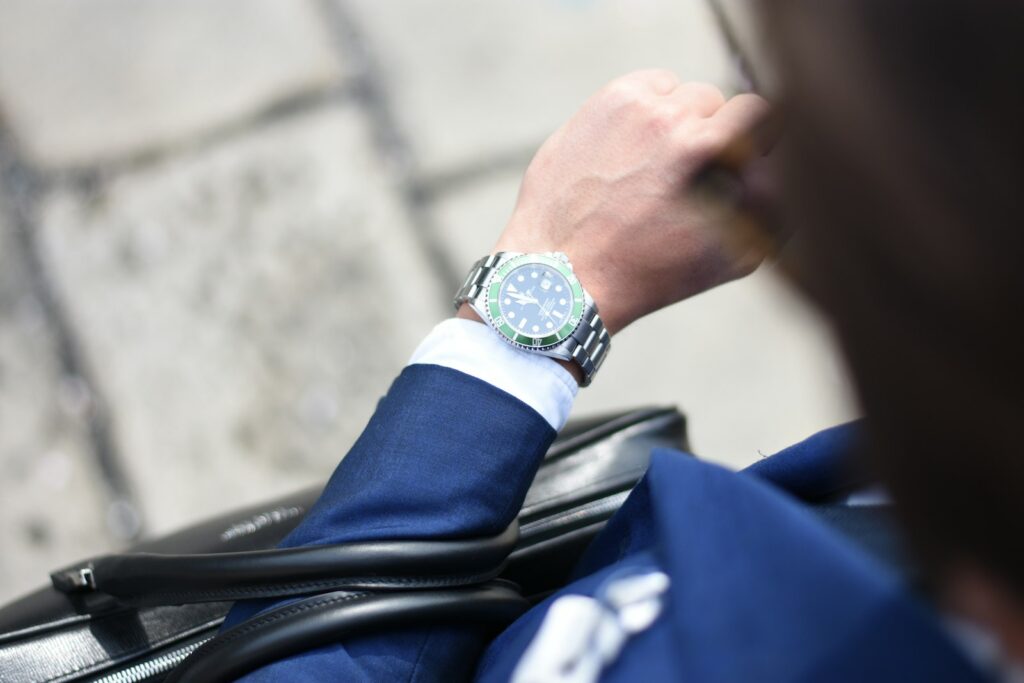
An everyday watch has a harder job than a special occasion one. It has to survive the commute, the keyboard, the gym bag and the weekend, look right with a T-shirt on Saturday and a blazer on Monday, and still be something you are happy to glance at a hundred times a day. Most men who end up disappointed with a watch did not buy a bad watch. They bought the wrong watch for the life they actually lead.
Here is how to choose one that you will wear every day for years, whatever your budget.
Start with your wrist, not the catalogue
Size is where most first purchases go wrong. Case diameter gets all the attention, but the number that decides whether a watch fits is the lug to lug measurement: the distance from the tip of the top lugs to the tip of the bottom lugs. If the lugs overhang the edges of your wrist, the watch looks too big however modest the diameter sounds.
As a rough guide, many men with average wrists find something in the region of 36 to 40mm in diameter the most versatile, while larger wrists can carry 40 to 42mm comfortably. Treat that as a starting point, not a rule. Thickness matters too. A slim case slides under a shirt cuff; a chunky one catches on it all day. If you can, try the watch on before buying, and look at it in a mirror from a normal distance rather than staring down at it.
Quartz or mechanical?
This is the biggest decision, and there is no wrong answer, just different trade-offs.
Quartz
A quartz watch is powered by a battery and regulated by a vibrating quartz crystal. It is more accurate than almost any mechanical watch, cheaper to buy, thinner and nearly maintenance free apart from a battery change every few years. If you want a watch that keeps excellent time and never needs thought, quartz is the practical choice. Solar powered quartz models, which charge from light, remove even the battery changes.
Automatic (self-winding mechanical)
An automatic watch is powered by a spring, wound by a rotor that swings as you move your wrist. There is no battery. People buy them for the engineering, the smooth sweep of the seconds hand and the sense of owning a small machine that could be repaired indefinitely. The trade-offs are cost, thickness and accuracy. For context, the Swiss COSC chronometer certification, a respected benchmark for mechanical movements, allows an average daily rate of minus 4 to plus 6 seconds. Many good automatics outside that certification drift a bit more, which means resetting the time every week or two.
An automatic will also stop if you leave it off for a day or two, depending on its power reserve, and it needs servicing every several years. Check the maker’s recommendation, because service costs vary a lot between brands.
Smartwatch
If you need notifications, fitness tracking and payments on your wrist, a smartwatch does jobs a traditional watch cannot. Many men end up with both: a smartwatch for training and a traditional watch for everything else.
Pick the right style for daily life
Certain categories of watch have earned their place as everyday choices because they work in almost every setting.
- Field watch. Simple, legible dial, often with Arabic numerals and a modest case. Rugged, casual and very easy to wear.
- Dive watch. A rotating bezel, strong lume and serious water resistance. Tough enough for anything and, on a bracelet, smart enough for most offices.
- Sports or “go anywhere” watch. Steel case and bracelet, clean dial, decent water resistance. The closest thing to a one-watch collection.
- Dress watch. Thin, understated, usually on a leather strap. Beautiful with tailoring, but more delicate and less happy in the rain or at the gym.
If you only want one watch, a steel sports, field or dive watch with a simple dial is the safest choice. Black, white, navy, grey or green dials all work with almost everything.
Water resistance: read the label correctly
Water resistance ratings are among the most misunderstood numbers in watches. The depth on the dial is based on a static pressure test, not a promise that you can take the watch to that depth. A watch marked 30 meters is best thought of as splash resistant: rain and hand washing are fine, swimming is not recommended. For everyday wear including swimming, look for at least 100 meters. Genuine dive watches are tested to a stricter standard, ISO 6425, and are marked “diver’s.”
Whatever the rating, keep the crown pushed in or screwed down, avoid operating buttons underwater unless the maker says you can, and have the seals checked when the watch is serviced.
Materials that last
- Case: stainless steel is the everyday standard. Titanium is lighter and hypoallergenic but scratches more visibly on some finishes.
- Crystal: sapphire is very scratch resistant and worth paying for on a daily watch. Mineral glass is cheaper and more likely to scratch; acrylic scratches easily but can be polished.
- Strap: a steel bracelet is the most durable and versatile. Leather looks great but suffers with sweat and water. Nylon and rubber are cheap, comfortable and easy to swap.
Choose a watch with standard lug widths and quick release spring bars, and you can change its whole character with a new strap in thirty seconds.
Legibility is underrated
You will read this watch hundreds of times a week, often in poor light and at a glance. Favor clear contrast between hands and dial, hands long enough to reach the markers, and some luminous material if you are ever outdoors at night. Busy dials packed with sub dials look impressive in photos and are tiresome in daily use.
Set a budget and stick to it
Good watches exist at every price. Well made quartz and automatic watches from established makers are available at accessible prices, and above a certain point you are paying mostly for finishing, brand and history. Remember to budget for the running costs: batteries for quartz, periodic servicing for mechanical. And be realistic about how you will treat it. A daily watch will pick up scratches, and the one you are nervous to wear is the one that ends up in a drawer.
The short version
Measure lug to lug, pick quartz for convenience or automatic for character, choose a simple steel sports, field or dive style, insist on at least 100 meters of water resistance and a sapphire crystal if you can, and make sure you can read it at a glance. Do that, and the watch will become part of how you dress rather than something you have to think about. For more on building a wardrobe around pieces like that, see our guide to dressing for a job with no dress code.